

Boundaries & Land Rights
To Survey or Not to Survey: A Fight in Maryland Over the Right to Survey
Maryland landowners have asked the U.S. Supreme Court to review an order allowing survey crews onto private land for a proposed power line. The dispute asks when a developer can gain access before its authority has been finally decided.
On This Page
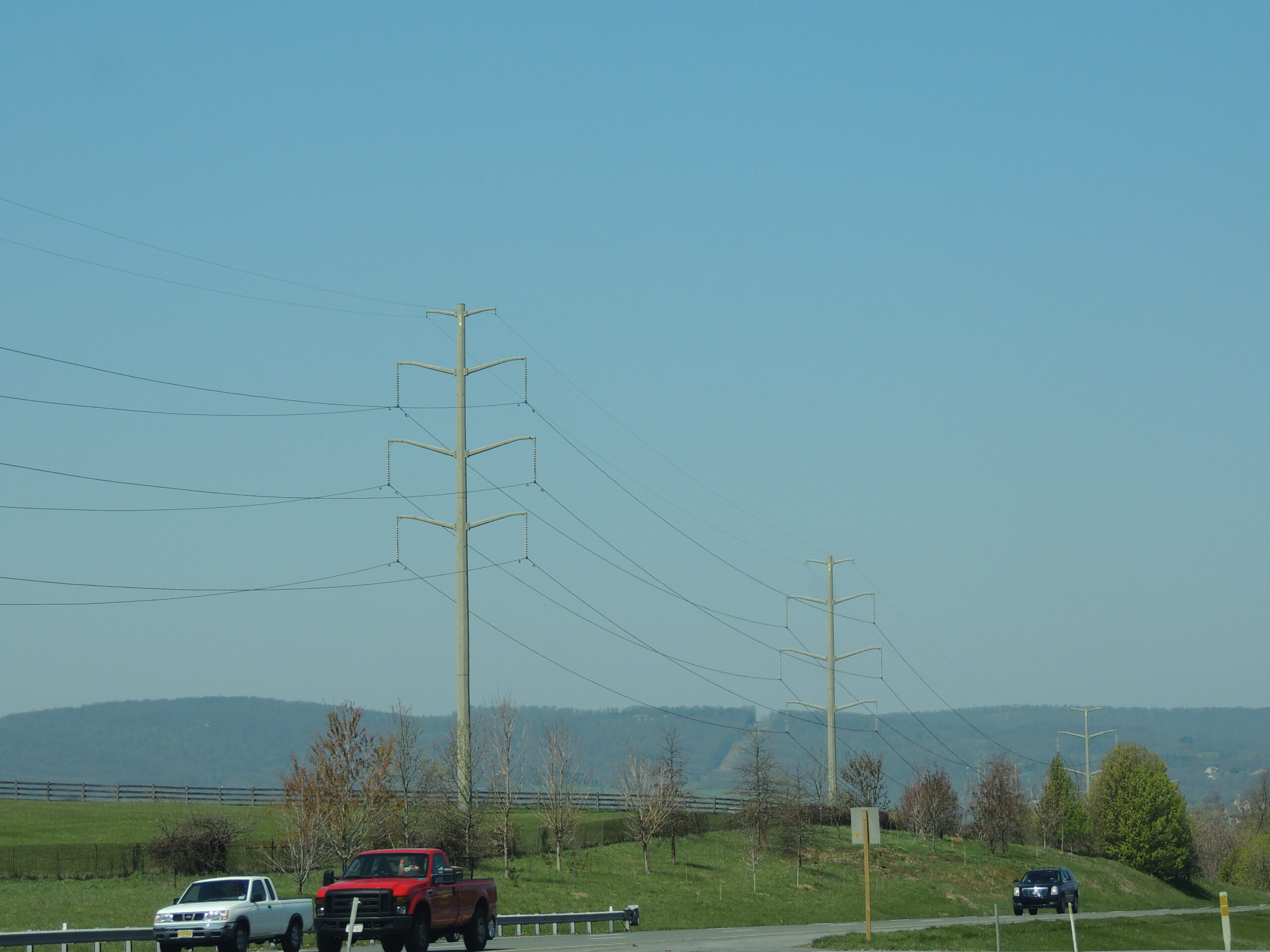
Featured photograph: An existing Potomac Edison transmission line in Frederick County, Maryland, photographed in 2016. It is separate from the proposed Maryland Piedmont project. Photo: Tonyglen14 via Wikimedia Commons, CC BY 2.0.

Before a survey crew can find out what lies on the other side of a fence, someone has to answer a question the instruments can’t: what gives the crew the right to cross it? Along a proposed power line in northern Maryland, that question has made its way to the U.S. Supreme Court.
On Nov. 4, 2026, Maryland landowners asked the justices to review an order that allowed PSEG Renewable Transmission LLC to enter private property for field studies. The proposed line still needed state approval. The order gave PSEG temporary survey access while the lawsuit proceeded. It did not transfer ownership, grant an easement, or authorize construction.
Why the fieldwork came before approval
PSEG’s Maryland Piedmont Reliability Project is a proposed 500-kilovolt line running about 67 miles (108 km) through Baltimore, Carroll, and Frederick counties. A proposed corridor can be drawn from public data, but the state review calls for evidence gathered on the ground. A line on a map might show where a route crosses a stream; field measurements can locate the banks and document the terrain an access road would have to cross. Maryland’s Power Plant Research Program told the Public Service Commission that PSEG’s application was incomplete without field studies. PSEG’s route summary shows how the company moved from a preliminary line on a map toward a proposed alignment that fieldwork could help evaluate.
When property owners refused access, PSEG turned to Maryland’s survey-entry statute, which permits specified professionals, including land surveyors, to enter for certain public-use investigations if they are acting on behalf of the state, one of its instrumentalities, or a body with eminent domain power. The law requires a genuine effort to give written notice and provides a route to seek a court order if permission is refused. The dispute was whether PSEG qualified to invoke that statute at this stage of the project.
Why the lower courts allowed entry
A federal district judge granted a preliminary injunction in June 2025. That is an order made while a lawsuit is still being decided. On Aug. 6, 2026, the Fourth Circuit upheld it. The majority reasoned that requiring a Certificate of Public Convenience and Necessity before entry would put PSEG in a bind: the field studies were needed to complete the application for that very certificate. It found no abuse of discretion in the district court’s conclusion that PSEG was likely to have the limited authority it claimed, given that Maryland’s Power Plant Research Program had directed the studies.
The distinction matters. The courts allowed access for the surveys needed for state review. The separate power to acquire property by condemnation for the transmission line would require the certificate. And whether to approve the project remains a question for the Maryland Public Service Commission.
The access also has limits. The Fourth Circuit explained that PSEG was not seeking authority for geotechnical surveys, which typically cause more than minimal incidental damage. Maryland’s survey-entry statute allows owners to seek damages for harm to their land or personal property caused by authorized entry. The amended injunction permits entry until the certificate application is granted or denied, so temporary access does not necessarily mean a single visit.
Why the landowners asked for review
The landowners’ petition focuses on whether a preliminary injunction can allow a private company to exercise eminent domain authority before that authority has been delegated. The landowners argue that PSEG has not received that authority and that a prediction of likely success cannot substitute for an existing right to enter. In their view, the injunction gave PSEG the very thing it went to court to obtain: entry over their objections. A later ruling could settle who had the better legal argument, but it couldn’t undo a survey crew’s visit. They also argue that federal appeals courts are divided over when preliminary injunctions may authorize entry or possession. As of Nov. 8, the Court had docketed the petition and had not agreed to hear the case. The docket listed Dec. 7 as PSEG’s response deadline.
The question a crew takes to the field
Florida surveyors will recognize the access question, even though the statutes work differently. Florida Statutes § 472.029 addresses entry by surveyors and mappers or their subordinates when necessary for surveying, mapping, or finding or setting monuments. It also limits what a crew may do to improvements without written permission and sets specific duties on agricultural land. The Maryland dispute turns on a different point: whether this developer could rely on its claimed authority for this project, at this stage.
For a crew, knowing where the property line lies and knowing what authorizes work across it are separate pieces of the job. The Maryland case shows why the second one belongs in the field plan. A line on a route map can tell the crew where the work is needed. The permission, statute, or order tells them how far that work can go.
Sources
- U.S. Supreme Court docket, Arentz Family, LP, et al. v. PSEG Renewable Transmission LLC, No. 26-600
- Landowners’ petition for a writ of certiorari (PDF)
- Fourth Circuit opinion, No. 25-1730, Aug. 6, 2026 (PDF)
- Maryland Public Service Commission, Case No. 9773
- Maryland Real Property § 12-111, entry for surveys and related work
- Florida Statutes § 472.029, entry onto third-party land
Discussion
Questions, field experience, and thoughtful observations are welcome.