

Boundaries & Land Rights
Benjamin Banneker: Looking to the Stars, Helping Shape a Capital
A Maryland farmer, astronomer, and almanac maker brought his skills to the new capital’s boundary survey—and used his pen to challenge one of the nation’s most powerful men.
On This Page
Before Washington had its great monuments, its boundaries had to be found. In early 1791, a surveying party worked from Jones Point beside the Potomac River, establishing the outline of the new federal district. Among the people contributing to those first observations was Benjamin Banneker, a free Black farmer from Maryland with an extraordinary interest in the sky.
Banneker’s part in the project lasted only a few months, but it connected a life of independent learning with a national undertaking. Later that year, he would make another connection: sending his astronomical work to Thomas Jefferson with a letter that asked the author of the Declaration of Independence to confront the meaning of equality.
Unknown artist / Maryland Historical Society, via PBS and Wikimedia Commons. Public domain. Source.

Learning on a Maryland Farm
Born in Baltimore County in 1731, Banneker grew up in a world where freedom and slavery existed side by side. He was free and eventually managed his family’s farm, yet the racial barriers around him were formidable. Formal education offered only part of his preparation. Reading, observation, and a sustained appetite for mathematics carried his studies much further.
The National Archives describes his attendance at a Quaker school and his continuing education through books and observations. Banneker’s story belongs to that long tradition of people who learn wherever the opportunity appears: at home, through a borrowed book, or by returning to a question until it begins to yield an answer.
His reputation also includes a wooden clock. Accounts celebrate his ability to understand its mechanism and make a working timepiece. The safest way to appreciate that achievement is on its own terms. It illustrates practical curiosity and patience; sweeping claims that it was the first clock made in America go beyond what the story needs.
Astronomy gave that curiosity a wider horizon. The changing positions of the sun, moon, and stars offered material for observation and calculation. Those same interests would make him useful to surveyors trying to connect a point on the ground with a position under the sky.
A Place in the Boundary Party
Major Andrew Ellicott led the federal district’s boundary survey. The original district was conceived as a square, ten miles (about 16 kilometers) on each side, covering one hundred square miles (about 260 square kilometers). Washington’s selection of the site still had to be translated into an outline people could recognize.
Banneker joined the early effort through his association with the Ellicott family. From February to April 1791, he assisted with astronomical observations and calculations connected to establishing the survey’s starting point at Jones Point. That contribution was part of a team project, with Ellicott responsible for the survey as a whole.
On April 15, the first boundary stone was ceremonially laid there. Banneker returned to Maryland while the party continued its work. His involvement was brief compared with the full survey, but the assignment placed his abilities in the service of a city that was still mostly a promise.

National Archives, NAID 135805001. Public domain (U.S. government photograph). Source.
The distinction between surveying the district’s boundary and designing Washington’s streets matters. L’Enfant drew the city plan; Ellicott revised and completed it for publication. Banneker’s documented place is in the early boundary work. Later stories that he recovered the entire city plan from memory should be treated cautiously; his surviving work offers a firmer basis for appreciating his achievements.
An Almanac for Everyday Life
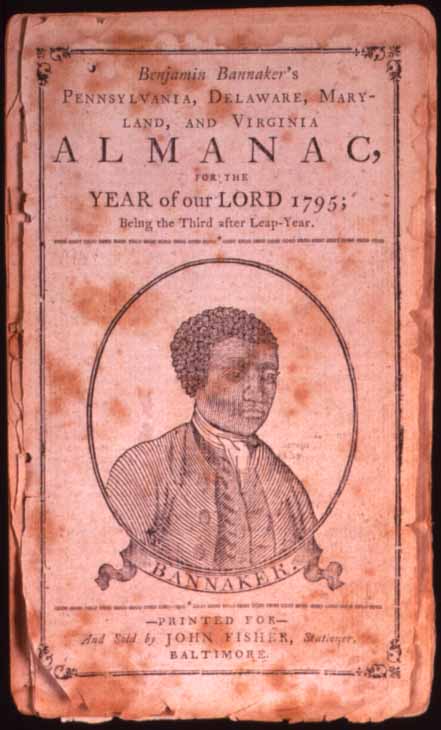
Back in Maryland, Banneker prepared the work that carried his name to a wider audience. His almanacs appeared annually from 1792 through 1797. They brought astronomical calculations into a format readers could use at home, combining calendar information with material about the natural world and daily life.
For a modern reader, an almanac can look like an odd mixture of subjects. Its appeal was precisely that mixture. Times of sunrise and sunset, eclipses, tides, verse, and practical information could sit together in a small publication intended to be consulted throughout the year.
PBS’s account of the 1795 almanac emphasizes how common such books were in households where other printed volumes might be scarce. Banneker’s calculations therefore reached people through an everyday object. His work moved from private study to something a reader could keep close at hand.
The surviving copies are also visually inviting. Their worn pages, compact printing, and elaborate titles make the eighteenth century feel tangible. The familiar woodcut associated with his 1795 almanac should be treated as a period depiction rather than a verified likeness. What the book itself establishes is more substantial: his name attached to published work.
A Letter with a Larger Purpose
On August 19, 1791, Banneker sent Jefferson a manuscript of his forthcoming almanac. The accompanying letter was courteous in form and forceful in substance. Jefferson had questioned the intellectual abilities of people of African descent in his writings; Banneker placed his own work directly before him.
He then pressed a moral question. The colonists had appealed to liberty while resisting British rule. How could those principles coexist with the enslavement of Black people? Banneker drew on shared humanity, Christian obligations, and the language of the Declaration to argue that the rights claimed by one group should extend to others.
The letter also asked Jefferson to consider the experience of people held in slavery. Its appeal to empathy gives the exchange an enduring human quality. A man known for calculations was asking a powerful official to reckon with lives that could not be reduced to a political convenience.
Jefferson replied on August 30, thanking him for the almanac and saying he would send it to the French scholar Condorcet. The exchange did not resolve the contradiction Banneker identified. It did preserve his challenge in his own words, and the letters were published together in 1792.
A Life That Holds Its Own
Banneker died in 1806. A fire soon afterward destroyed many of his possessions, leaving gaps that later stories have sometimes filled too confidently. His surviving publications and correspondence deserve the attention that legend can distract from.
They reveal a farmer who pursued astronomy, an assistant who contributed to the early boundary of a capital, and a writer prepared to address a secretary of state on the subject of human dignity. Each role adds something to the portrait.
At Jones Point, the remaining boundary monument offers a modest place to begin thinking about him. The larger story continues in the almanacs and the letter: a life in which careful observation and an independent voice found their way far beyond a Maryland farm.
Sources and further reading
National Archives: The Extraordinary Benjamin Banneker
National Park Service: Benjamin Banneker and the Boundary Stones
National Park Service: The Nation’s Capital Begins Here
PBS: Benjamin Banneker’s Almanac
National Park Service: Banneker–Jefferson letters, with transcript
Library of Congress: The published correspondence
National Park Service: Benjamin Banneker’s wooden clock
Smithsonian Libraries: Banneker’s work and the legends around it