

Measuring the World
Measuring the Earth–Moon System: Lunar Laser Ranging and Millimeter Geodesy
How Apollo-era retroreflectors let observatories measure the Moon, test gravity, and strengthen lunar reference frames.
On This Page
- 01 — Introduction
- 02 — A reflector that needs no power
- 03 — Timing the round trip
- 04 — Sidebar: why tiny timing errors matter
- 05 — The observing station is part of the measurement
- 06 — Precision needs a separate accuracy check
- 07 — A long record reveals a moving system
- 08 — Sources and further reading
Series: Surveying the Space Age
The target is on the Moon, the instrument is on Earth, and almost all the light misses the telescope on the way back. Lunar laser ranging succeeds anyway. By timing the small number of photons that return from a lunar reflector, observatories measure a distance of roughly 240,000 miles (386,000 kilometers) with a sensitivity that would seem ambitious across a construction site.
The measurement is simple to describe and demanding to make: send a short laser pulse, record its return, and convert the travel time into a range. Getting a useful scientific answer requires knowing what happened to the pulse along the way, where the observatory was, and how the reflector moved while the light was traveling.
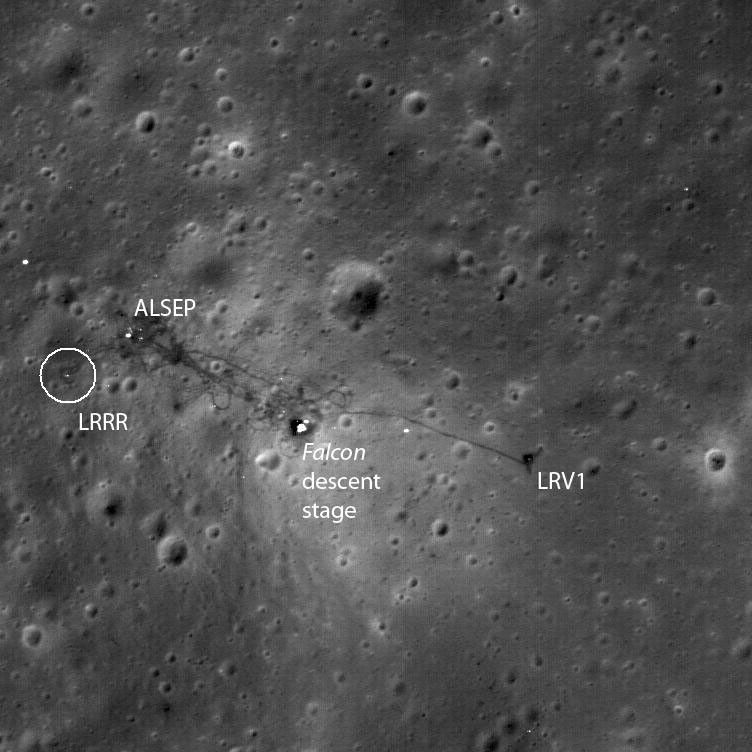
NASA/GSFC/Arizona State University, PIA13037. Public-domain government image. Source.
A reflector that needs no power
Apollo 11, 14, and 15 crews left arrays of corner-cube reflectors on the lunar surface. The Soviet Lunokhod rovers carried reflectors too. Their geometry returns incoming light toward its source across a range of directions. The hardware needs no electrical supply to send a response; the “reply” is reflected light.
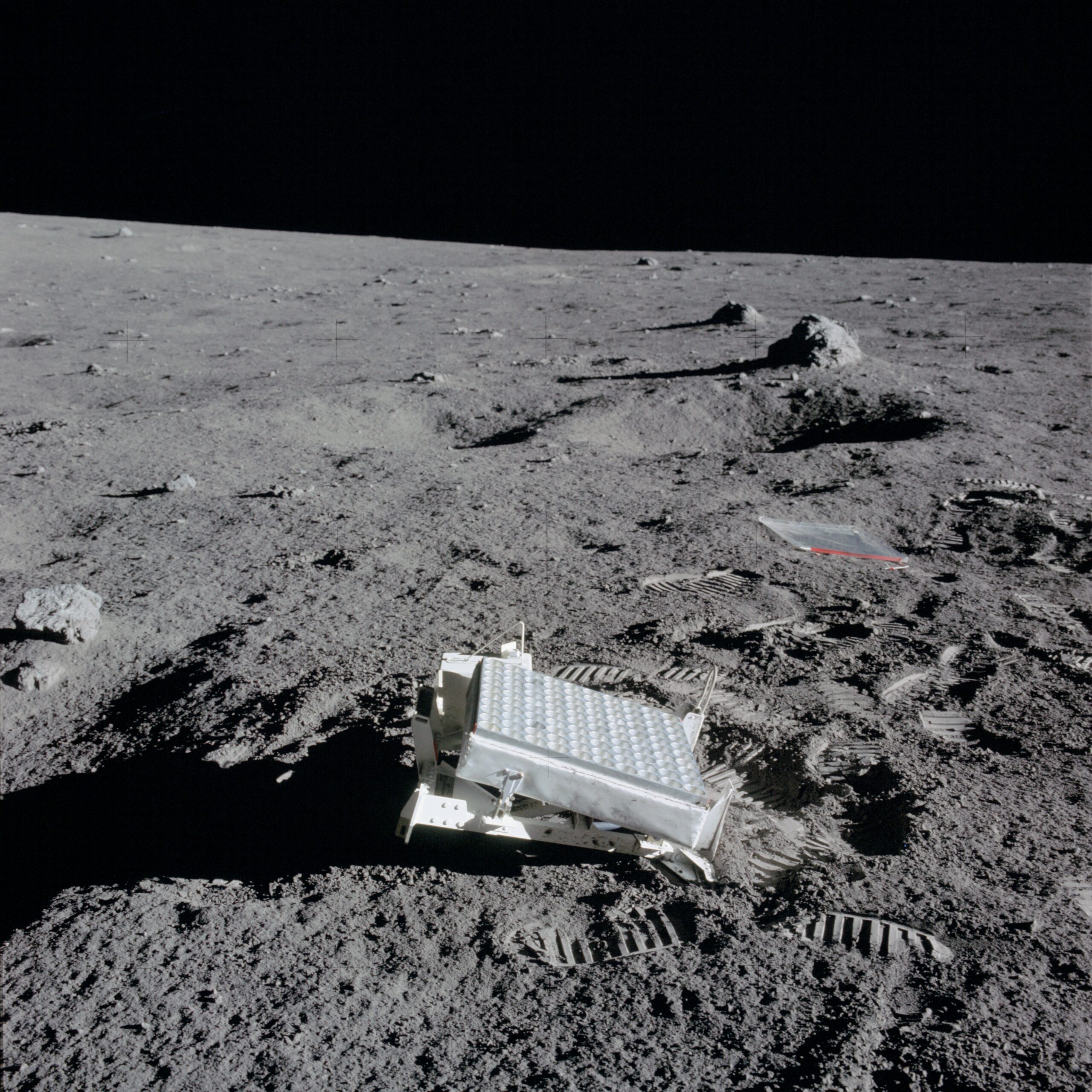
NASA, Apollo 14 image AS14-67-09386. Public-domain government image. Source.
That passive design explains the experiment’s unusual longevity. The ground equipment can improve while an old lunar target remains useful. The International Laser Ranging Service documents the longstanding network and newer targets, including the NGLR-1 reflector delivered by Blue Ghost in 2025. The history is still being extended.
Timing the round trip
The pulse takes about two and a half seconds to travel out and back. The first approximation to the distance is light speed multiplied by the measured round-trip time, divided by two. The division is essential: the clock has timed both legs of the journey.
That gives a station-to-reflector range, not automatically the distance from Earth’s center to the Moon’s center. Turning it into an orbital measurement requires a model of both bodies and the locations of the endpoints. Earth rotates during the observation, the Moon moves, and the atmosphere slows the light slightly relative to its speed in vacuum.
Sidebar: why tiny timing errors matter
For an illustrative round-trip timing error of one nanosecond, the corresponding one-way range error is about 5.9 inches (15 centimeters). The calculation uses c × Δt / 2, with the defined vacuum speed of light, c = 299,792,458 meters per second. A picosecond is one-thousandth of a nanosecond. These units describe time; no instrument earns a small distance uncertainty merely by displaying enough digits.
The observing station is part of the measurement
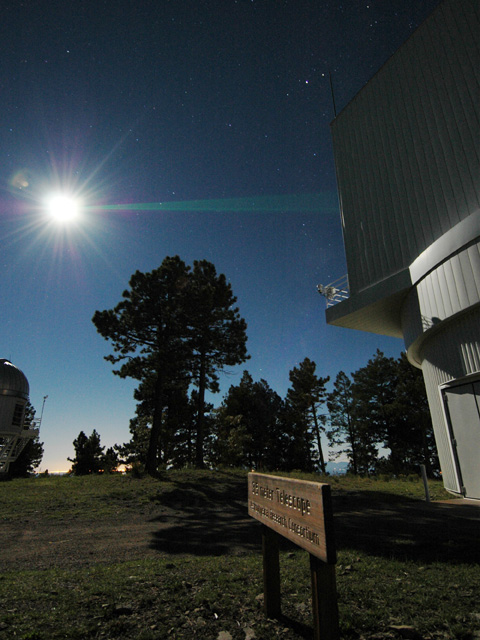
Dan Long (M3long). CC BY-SA 4.0. Source. Resized by WordPress.

The atmosphere, the telescope, the detector, and the timing electronics all contribute to the result. Pressure and other weather observations help model atmospheric delay. The observatory’s position must be expressed in a terrestrial reference frame, including motion that matters at the intended precision.
The lunar endpoint is not perfectly simple either. As the Moon presents slightly different orientations to Earth, the elements of an array can lie at different ranges. That broadens the distribution of return times. The observing system therefore gathers many photons and combines them into a summarized measurement, usually called a normal point, rather than treating one return as a complete answer.
Precision needs a separate accuracy check
Repeated results can cluster tightly and still share a bias. Precision describes that clustering; accuracy concerns agreement with the correct value. Lunar ranging needs both, and calibration is what helps distinguish them.
A 2023 study of the APOLLO experiment reported a median nightly range uncertainty of about 0.067 inch (1.7 millimeters) for observations beginning in 2006. An added absolute calibration system exposed a small systematic timing error in earlier hardware. Applying its corrections reduced estimated systematic errors below about 0.04 inch (1 millimeter). Those results concern processed observations and calibrated data, not a promise that every individual laser pulse measures the Moon to that accuracy.
A long record reveals a moving system
The value of the experiment grows as observations accumulate. Lunar ranges help test models of the Moon’s orbit and rotation, the response of Earth and Moon to tides, and gravitational physics. The ILRS scientific overview describes these uses. Different effects leave different signatures over time, so a long record can separate changes that one exceptionally precise night cannot.
There is a familiar surveying idea beneath the extraordinary distance. A durable target becomes more useful when its history remains connected to careful observations and a well-defined reference system. The lunar reflectors have been sitting in place for decades; the understanding of what their returned light tells us keeps improving.
Sources and further reading
ILRS: lunar laser ranging targets and science; Colmenares and colleagues, 2023: APOLLO data reduction and calibration; NASA: lunar laser-ranging observations.