

Engineering & Infrastructure
Before Liftoff: Surveying, Control, and Alignment at a Launch Complex
How construction control, structural monitoring, precision alignment, and verification support a rocket before it leaves the pad.
On This Page
- 01 — Introduction
- 02 — The Pad Is a Coordinate Problem
- 03 — Large Structures, Specific Interfaces
- 04 — The Launcher Must Arrive in the Same System
- 05 — A Documented Alignment Survey
- 06 — A Closer Look: A Small Angle at a Tall Structure
- 07 — Temperature and Load Give Dimensions a Date
- 08 — The Work Before the Countdown
- 09 — Sources and Further Reading
The rocket gets the attention, but the launch pad has to be in the right place first. Foundations, service connections, access structures, and the vehicle’s support points must fit together in three dimensions. Much of the surveying happens long before the countdown becomes interesting to anyone watching from a distance.
A spaceport combines familiar construction problems with unusual scale and consequences.
The Pad Is a Coordinate Problem
Survey control gives different crews a common framework for position and elevation. A foundation contractor and a team installing a service connection may work months apart, yet their components must meet. The coordinates need a defined origin, orientation, units, and vertical reference. The reference marks also need to remain stable while the ground around them changes.
A local engineering grid can make the design convenient to use, but it must be related deliberately to the broader site survey. A coordinate from one drawing cannot safely be copied into another merely because both happen to be expressed in feet. The apparent precision of the numbers says nothing about whether their origins agree.
Large Structures, Specific Interfaces
NASA’s description of Launch Pad 39B gives a sense of scale: a flame trench about 450 feet (137 meters) long and lightning towers about 600 feet (183 meters) high. It describes the “clean pad” approach, with basic services at the pad and vehicle-specific needs met through the structures that accompany the rocket.
For a surveyor, the important word is interface. A large structure may be broadly in the right place while a connection on it is wrong. As-built measurements compare what was constructed with the intended location and geometry. They help expose a mismatch while there is still time to correct it.
The Launcher Must Arrive in the Same System
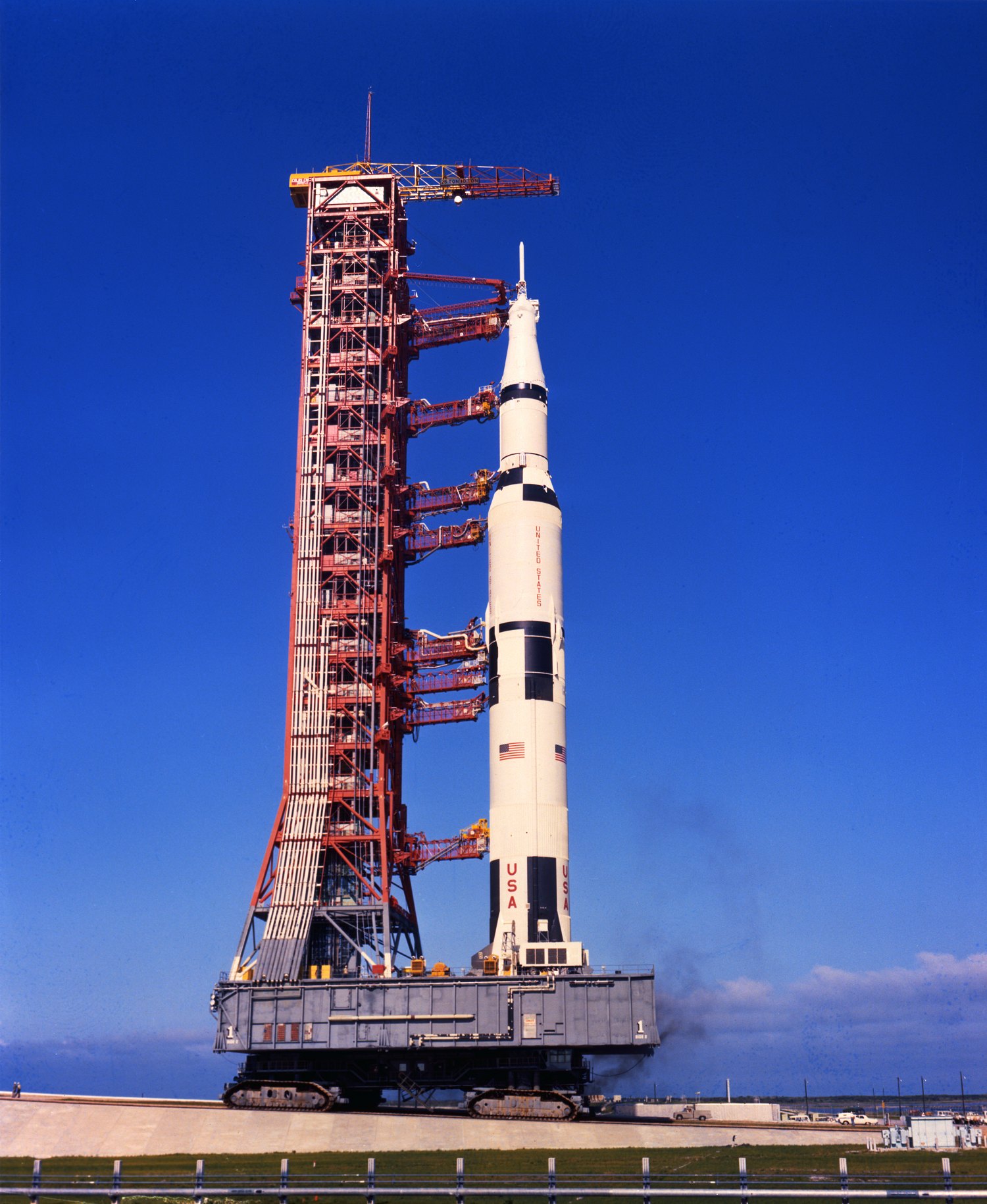
NASA, photograph 69-HC-622; scan by Kipp Teague, via Wikimedia Commons. Public domain in the United States. Source.

The Apollo 11 photograph shows the crawler-transporter carrying the Saturn V and mobile launcher toward Pad 39A in 1969. It records a transportation operation as well as a spaceflight milestone. The structure has to travel, reach its support position, and meet the pad’s systems.
That makes the route part of the geometric problem. Clearance, support elevations, and changes under load can matter between the assembly building and the pad. The photograph does not establish a particular surveying tolerance; it shows why a launch complex cannot be understood as one fixed point beneath a rocket.
A Documented Alignment Survey
A firsthand account in The American Surveyor describes work for Atlas V flight AV-025 in 2010. Survey control was established for measurements of the booster and Centaur bodies. The three retractable launch heads defined the launch center. The same account describes a later job for AV-027 in December 2010 and January 2011, when alignment was checked before and after installation of its single solid rocket booster.
The useful detail is the change of configuration. Measuring a vehicle once does not describe every later condition. Adding a major component can alter loading, and the alignment survey is tied to the state in which the measurements were taken. This is a specific Atlas example, not a universal procedure for every NASA or commercial vehicle.
A Closer Look: A Small Angle at a Tall Structure
Suppose a point is 300 feet (91.4 meters) above a reference and an axis is tilted by 10 arcseconds. The corresponding lateral offset is about 0.175 inch (4.4 millimeters), using offset = height × tangent of the angle. The numbers are illustrative, not a launch requirement. They show why an apparently tiny angular difference can become a measurable displacement over a tall structure.
Temperature and Load Give Dimensions a Date
Steel and concrete change with temperature, and structures deflect under load. A measured dimension therefore describes a condition, not necessarily a permanent shape. Records of temperature, loading, configuration, and observation time help an engineer distinguish expected movement from an installation error.
Independent observations are valuable here. Measurements from another instrument position can test the first geometry, while a separate reference can help reveal movement in a control point. Repeating the same setup may improve consistency without exposing a shared mistake in its orientation or reference.
The Work Before the Countdown
Launch-site surveying turns separate pieces of engineering into a structure whose relationships can be checked. The work is rarely the most visible part of a launch, but it answers a question the flame and noise arrive too late to settle: did everything meet where the design said it should?
Sources and Further Reading
The American Surveyor: Surveying Rockets—Launch Vehicle Alignment Survey, 2012
NASA Apollo 11 rollout photograph, archival image and rights record