

Exploration & Navigation
Finding the Moon: Reference Frames, Optical Sights, and Apollo Navigation
How inertial platforms, optical observations, radio tracking, maps, and reference frames guided Apollo between Earth and Moon.
On This Page
- 01 — Introduction
- 02 — Position Is Not the Same as Attitude
- 03 — The Inertial Platform Carries the Reference
- 04 — What the Optical Sights Added
- 05 — A Closer Look: Why One Direction Is Not Enough
- 06 — The Ground Supplied Another View
- 07 — Apollo 13: When the Expected Stars Disappeared
- 08 — A Reference That Could Survive a Bad Day
- 09 — Sources and Further Reading
Apollo’s astronauts could see the Moon long before they reached it. Seeing the destination was the easy part. They still needed to know where the spacecraft was, how fast it was moving, and which way it was pointing before an engine burn could put them on the desired path.
Those are related questions, but they are not interchangeable. Apollo answered them with inertial instruments, optical sightings, radio tracking, computers, and people comparing the results. The surveying connection lies in that combination: a measurement becomes useful when its reference and meaning are understood.
Position Is Not the Same as Attitude
Position describes where a spacecraft is within a chosen coordinate system. Velocity describes how that position is changing. Attitude describes its orientation. Time ties the observations and predictions together. A spacecraft can be at the right place and still point its engine in the wrong direction.
A familiar field analogy helps. Setting an instrument over a known survey mark establishes its location, but the horizontal circle still needs an orientation. Knowing one does not supply the other. Spaceflight adds motion, changing gravitational influences, and the need to keep the solution current.
The Inertial Platform Carries the Reference
Apollo’s inertial measurement unit combined gyroscopes and accelerometers on a stabilized platform. The gyroscopes supported the directional reference; the accelerometers measured changes associated with applied forces. The computer used this information with an initial state and a mathematical description of motion to carry the navigation solution forward.
An inertial unit does not independently discover its starting position or make alignment errors disappear. A small error in the reference can affect how later measurements are interpreted. External observations were therefore valuable for setting and checking the system, rather than simply accumulating more readings inside it.
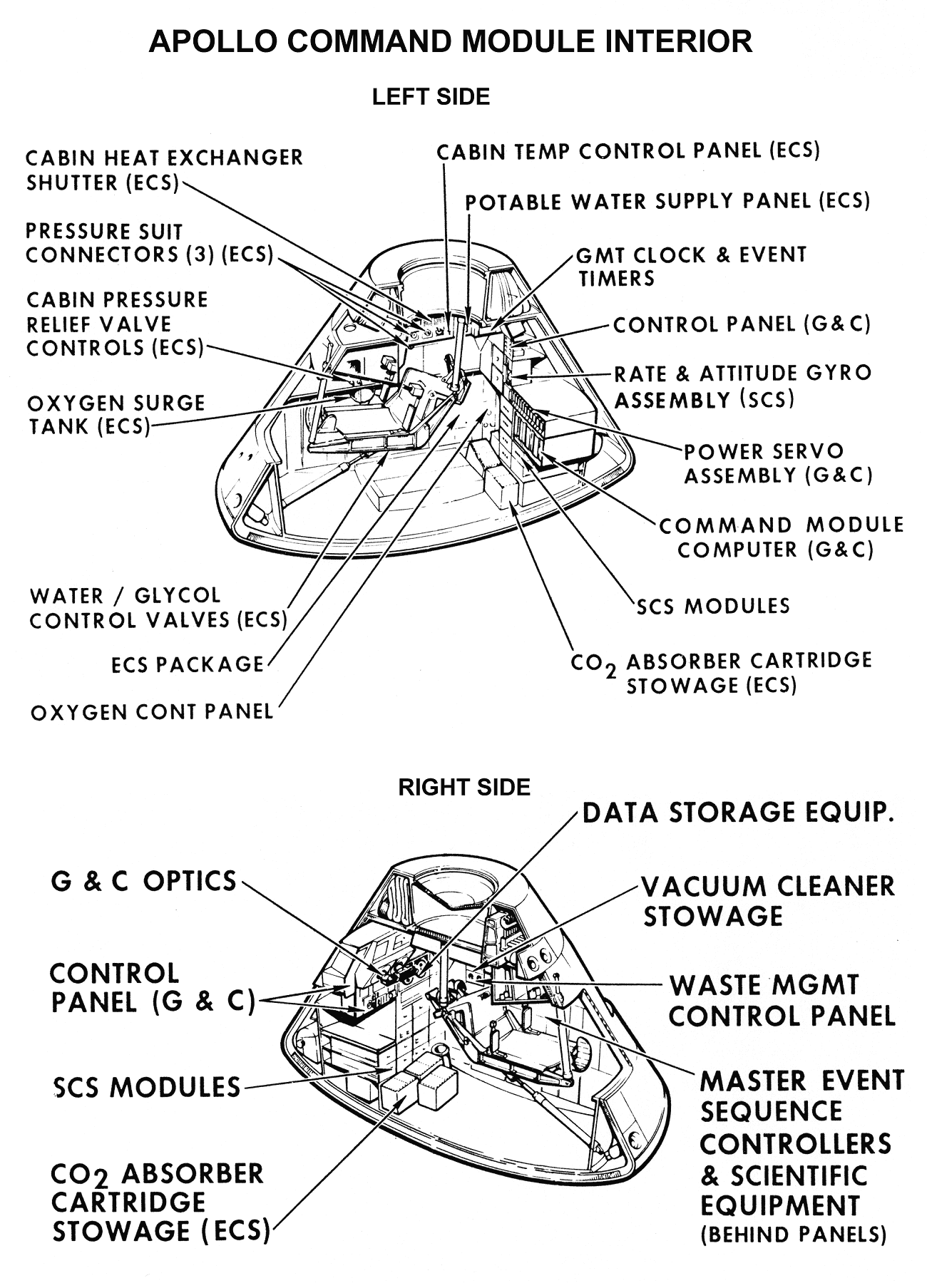
NASA, Apollo Training Manual, 1968. Used under NASA’s media usage guidelines. Source. View the full-size diagram.
What the Optical Sights Added
The Command Module’s optical system included a sextant. Its two lines of sight allowed angular observations, including relationships between a star and an Earth or Moon feature. Stars also supplied directions for checking the inertial platform. The training diagram above locates the observing equipment within the Command Module, alongside the computer and controls the crew used.
The astronaut had to identify the target, bring the appropriate images into the intended relationship, and record the observation at the right time. A precise angle to the wrong star would still be wrong. Nor does a direction to a distant star, by itself, tell you the spacecraft’s distance from Earth.
A Closer Look: Why One Direction Is Not Enough
Imagine pointing a pencil directly at a star. You can turn the pencil around its own long axis without changing where its tip points. One known direction leaves that rotation unresolved. A second suitable, nonparallel direction supplies additional orientation information. This geometric example explains why checking one sight line and establishing a complete three-dimensional attitude are different tasks.
The same distinction matters when reading an account of an emergency. A sighting may verify a previously established alignment or constrain part of it without constituting a complete, independent navigation fix.
The Ground Supplied Another View
Radio tracking added information with different strengths. Signal travel time provides range information, while Doppler measurements reveal motion along the line of sight. A sequence of observations, interpreted with a trajectory model, helps determine the spacecraft’s path. NASA’s navigation reference explains why neither range nor Doppler alone directly supplies every component of motion.
This made communications part of the measurement system as well as the conversation. Ground teams could compare predictions with tracking and pass updates to the crew. The onboard instruments and the ground solution complemented one another; they were not simply two displays of the same observation.
Apollo 13: When the Expected Stars Disappeared
After Apollo 13’s oxygen-tank accident in April 1970, sunlit debris and venting gas made normal star identification difficult. The Lunar Module became essential to the return home, including the propulsion and guidance work needed to reshape the trajectory. Procedures had to fit damaged equipment, limited power, and the references the crew could actually see.
John Goodman’s technical account describes the use of the Sun, Moon, and Earth when the normal optical procedures were compromised. A Sun sighting could help check an alignment; it should not be described as though one bright object alone supplied a complete position and orientation. The emergency work combined available observations, existing information, revised procedures, and close coordination with Mission Control.
NASA’s historical account adds a telling change in conditions: at 76 hours 42 minutes into the flight, the spacecraft entered the Moon’s shadow and stars became visible through the surrounding debris. The stars had not moved into a better arrangement. The lighting had changed what the astronauts could distinguish.
A Reference That Could Survive a Bad Day
Apollo 13 gives the technical story a human scale. The crew and ground teams needed more than a backup instrument. They needed to understand which relationship a measurement could establish, what remained uncertain, and which other evidence could fill the gap.
That is the enduring connection with surveying. A dependable result comes from measurements that can be explained and checked against something outside themselves. Apollo carried that discipline into a moving spacecraft, where a direction in the sky could become one part of the way home.
Sources and Further Reading
Smithsonian: Apollo sextant optical unit
NASA: Basics of Space Flight, Chapter 13, Navigation
John L. Goodman: Apollo 13 Guidance, Navigation, and Control Challenges, 2009
NASA: “Houston, We’ve Had a Problem,” the mission chronology