

Boundaries & Land Rights
Boundaries in the Bible: Landmarks, Measuring Lines, and the Language of Inheritance
The Bible is not a surveying manual, but its laws, narratives, and prophetic images preserve a world in which moving a stone could threaten a family’s future and measuring land could symbolize order, judgment, or restoration.
On This Page
- 01 — Introduction
- 02 — The Stone and the Inheritance
- 03 — Joshua: Walk the Land, Write the Description
- 04 — A Public Transaction at the Gate
- 05 — Measuring Tools Become a Language
- 06 — Ezekiel Measures an Ordered World
- 07 — A Closer Look: Which Cubit?
- 08 — What the Old Words Leave Us
- 09 — Sources and Further Reading
Moving a boundary stone is a small act with large consequences. The warning in Deuteronomy 19:14 assumes that a marker set by earlier people still matters to those who inherit the land. To a surveyor, that concern feels familiar. A point on the ground carries a decision across generations, and disturbing it can injure someone who never saw the original line established.
The Bible approaches land through law, family stories, territorial descriptions, poetry, and visions. Those forms should not be read as though they were pages from one surveying textbook. What they share is an understanding that land has to be described, divided, remembered, and protected.
The Stone and the Inheritance
Deuteronomy 19:14 prohibits moving a neighbor’s landmark in an inherited holding. It does not tell us the marker’s dimensions, the instrument used to set it, or how a disputed position would be recovered. The point is the neighbor’s entitlement and the continuity of an earlier allocation.
That is a more useful connection to present surveying than imagining an ancient crew using modern procedures. The marker matters because people recognize what it represents. A stone without that relationship is simply a stone; a recognized boundary mark connects a physical place with rights and memory.
Joshua: Walk the Land, Write the Description
In Joshua 18:4–10, representatives are sent through the land, return with a written description in seven parts, and the remaining allotments are distributed by lot at Shiloh. The passage separates observation, recording, and allocation. The lot decides a share; it does not measure the ground.
Later in the chapter, Benjamin’s territory is described by a sequence of places and landscape features. The boundary climbs, descends, and turns as it passes named settlements, mountains, springs, and valleys. This is a description meant to be followed through a known landscape. The chapter supplies no list of bearings and distances from which a modern reader could compute a closed parcel.
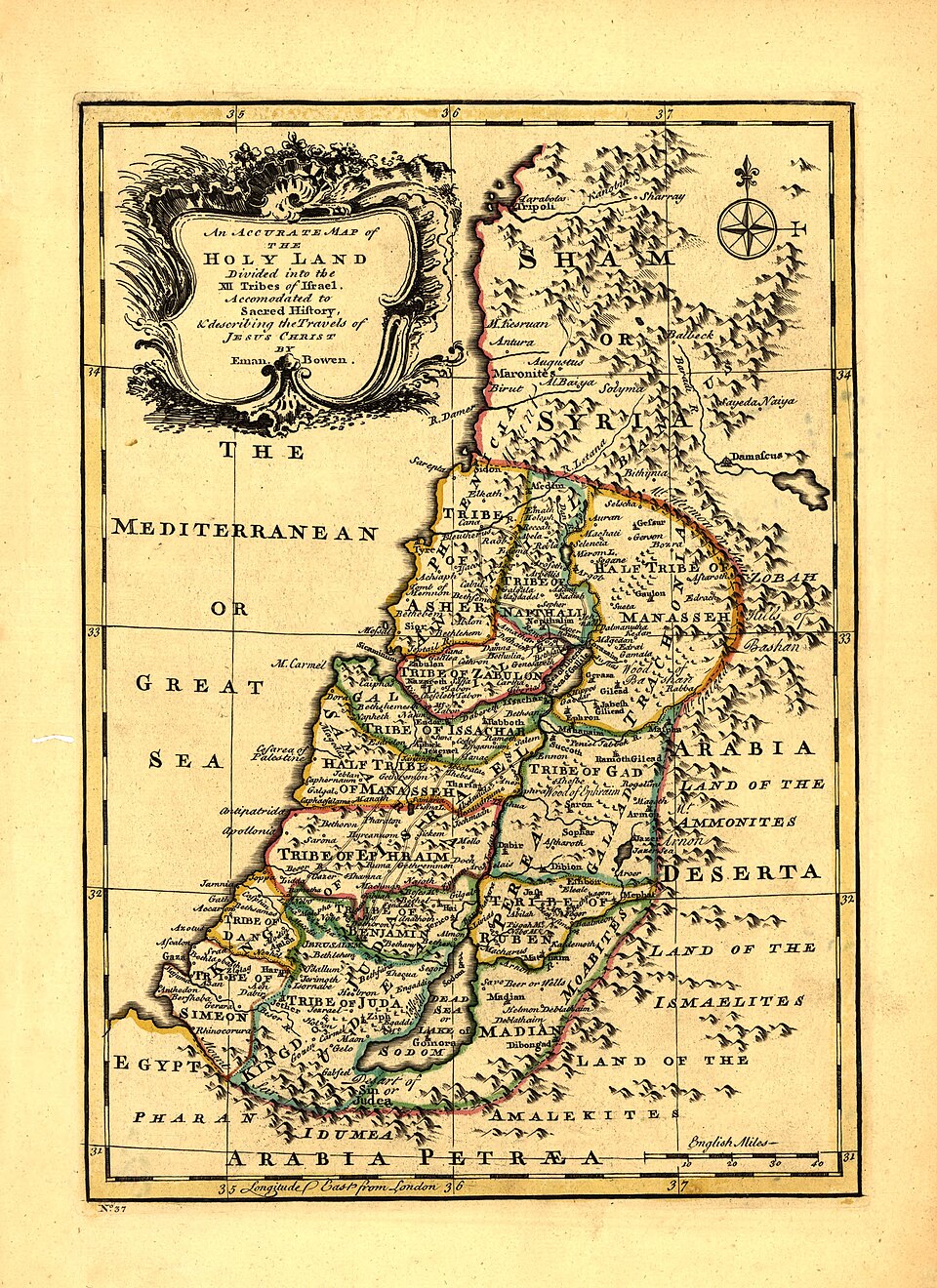
Emanuel Bowen; Library of Congress. Public domain. Source. Resized by WordPress.
Emanuel Bowen’s 1752 map shows how a later cartographer pictured the tribal territories. The map’s colored territories let the reader compare adjoining allotments across the whole region. The Library of Congress record identifies its maker and date. Keeping those dates in mind lets us enjoy the map without asking it to prove more than it can.
A Public Transaction at the Gate
Landholding also appears in stories about families and public recognition. In Ruth 4, Boaz conducts a transaction before elders at the town gate. The narrative ties property, kinship, marriage, and continuation of a family’s name together. Witnesses explicitly acknowledge what has taken place.
The scene shows how ownership is made public through a procedure people recognize. Written descriptions and physical markers belong to a wider social world; they do not explain that world by themselves. The gate scene makes that human setting unusually visible.
Measuring Tools Become a Language
A line can divide a field or test whether a wall stands true. That practical authority gives measuring tools their force as images. In Amos 7:7–9, many English translations present a plumb line or plummet in a vision of judgment. The Hebrew term has been debated, so the passage should not be treated as an unambiguous technical description of an instrument. In the familiar translation, the image is powerful because a wall cannot negotiate its way into being upright.
Such passages tell us something about the meanings attached to measurement. They do not establish that prophetic writers were describing a professional survey organization. The difference matters: a metaphor can preserve the cultural importance of a tool without providing its operating instructions.
Ezekiel Measures an Ordered World
Ezekiel 40 begins a vision in which a figure holds a linen cord and measuring rod. Gates, walls, courts, and rooms are measured in a sequence that gives the imagined temple a deliberate spatial order. Access and separation are part of its meaning. The text invites the reader to move through measured space, even though it is not an excavated construction plan.
A Closer Look: Which Cubit?
Ezekiel 40:5 specifies a measuring rod of six cubits, with each cubit described as a cubit plus a handbreadth. That qualification is important. The unit is part of the record, not something a modern reader can silently replace with a universal conversion. The USCCB note gives the longer cubit as approximately 20.4 inches (51.8 centimeters), making six about 10.2 feet (3.1 meters). These are approximate modern equivalents.
What the Old Words Leave Us
The most interesting connection across these passages is the effort to make something last: an inheritance, a recorded allocation, a witnessed transaction, or an idea of restored order. Measurement helps make the decision visible, while people give it authority. A boundary stone is small enough to move by hand. The reason its movement matters is everything the community has placed behind it.
Sources and Further Reading
Deuteronomy 19:14: comparison of English translations
Joshua 18: description and allotment
Ruth 4: public witnesses and inheritance