

Measuring the World
Surveying Across the Seas, Part 2: John Harrison and the Clock That Carried Longitude
How John Harrison’s marine timekeepers turned reference time into a practical east-west position at sea.
On This Page
- 01 — Introduction
- 02 — A Clock Has to Survive Its Journey
- 03 — H1, H2, and the Long Detour Through H3
- 04 — The Watch-Sized Change of Direction
- 05 — Trials, Payment, and a Disputed Finish
- 06 — A Closer Look: Why a Clock’s Rate Matters
- 07 — Kendall’s Copy Takes the Idea Further
- 08 — A Reference That Could Travel
- 09 — Sources and Further Reading
Series: Surveying Across the Seas
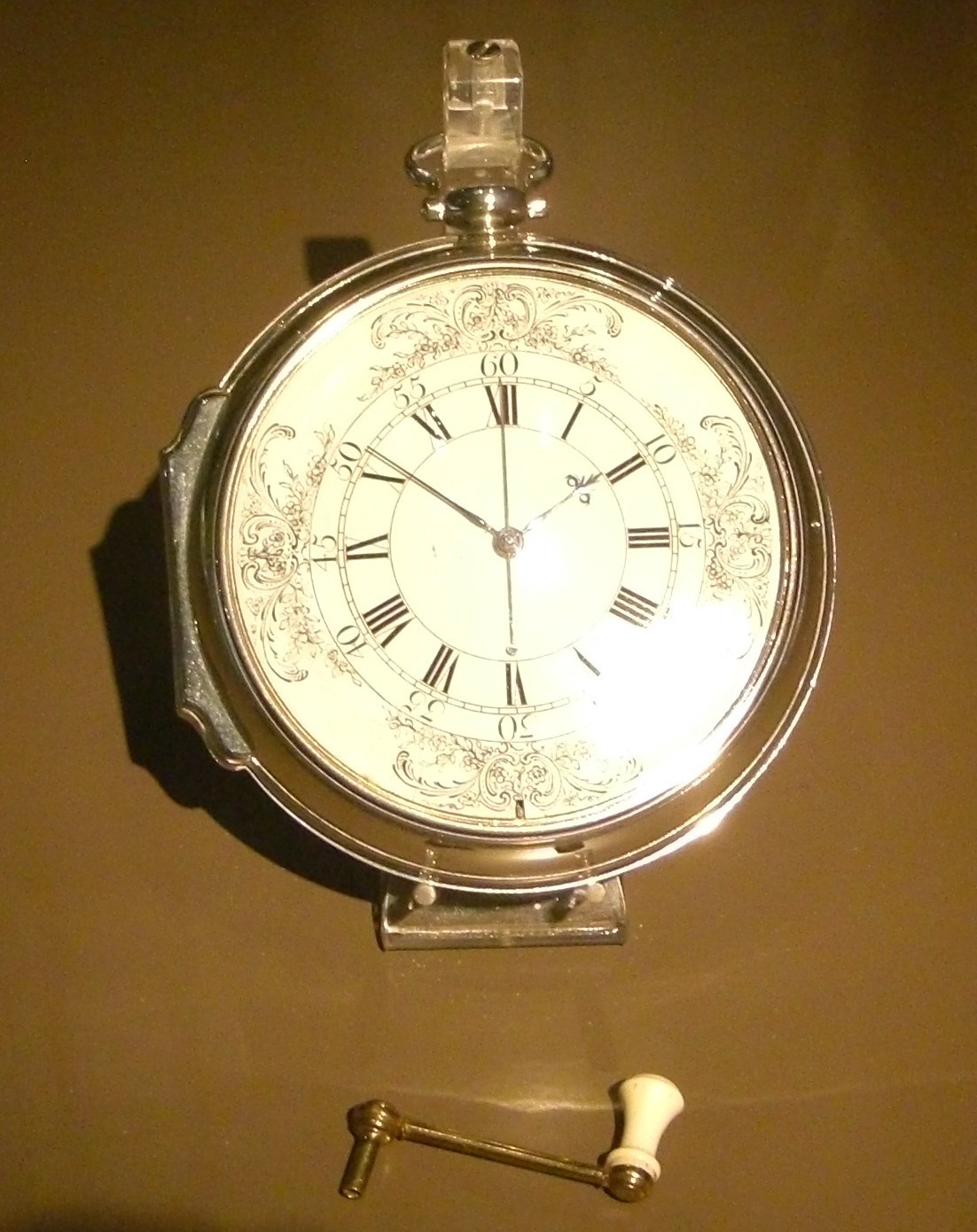
John Harrison’s fourth marine timekeeper looks like an oversized pocket watch. That is part of its surprise. After years spent building much larger machines, Harrison found his successful approach in something that could fit in a carrying case. H4 did not display a ship’s longitude. It preserved the time needed to calculate it.
The distinction matters. A shipboard clock, a sight of the sky, and an astronomical calculation had to work together. Harrison took on the piece of that system that ordinary clocks could not supply: dependable time after weeks at sea.
Photograph by Colonel Warden at en.wikipedia, via Wikimedia Commons. CC BY-SA 3.0. Source.

A Clock Has to Survive Its Journey
A clock counts repeated motion. In a pendulum clock, the pendulum’s swing sets the pace; in a watch, a spring and balance provide the oscillation. To keep good time, that pace must stay stable while the mechanism continues to receive energy. Friction, changing spring force, temperature, and movement can disturb it. At sea, those are everyday conditions rather than occasional laboratory nuisances.
Harrison came to clockmaking through carpentry and practical mechanics. He pursued the longitude problem by trying to make the timekeeper itself resist those disturbances. It was an unusually physical problem: if a small change in a spring or bearing altered the rate, the navigational consequence would grow quietly with every day of the voyage.
H1, H2, and the Long Detour Through H3
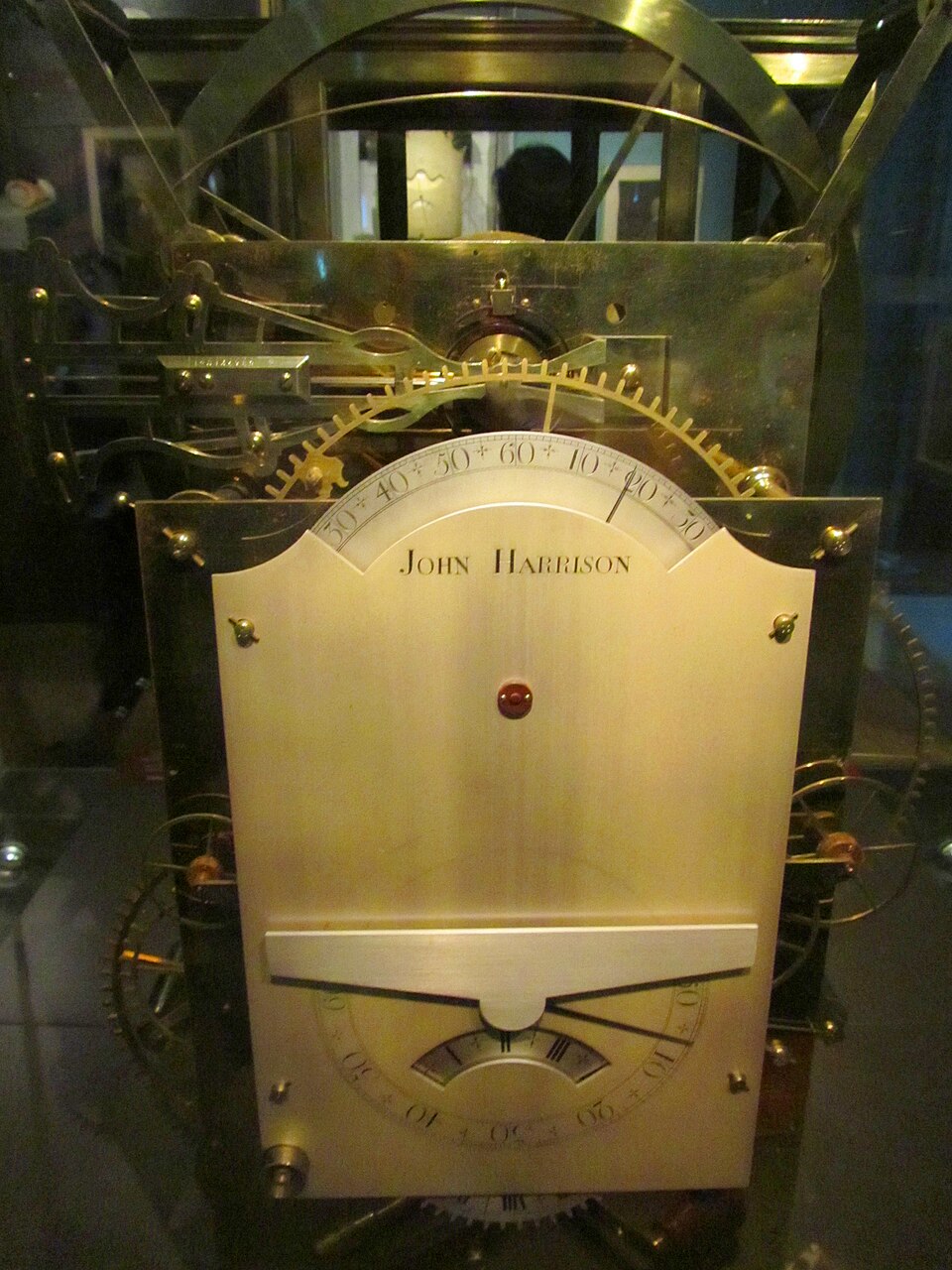
Harrison completed his first marine timekeeper, H1, in 1735 and took it on a Lisbon voyage in 1736. Its linked balances addressed ship motion without relying on an ordinary pendulum. H2 followed, but Harrison found a defect and did not send it to sea for an official trial. He began H3 in 1740 and spent nearly 19 years developing it. This was no straight march from rough prototype to finished watch.
Bin im Garten. CC BY-SA 3.0. Source. Resized by WordPress.

The museum record for H3 identifies two lasting inventions in that unsuccessful timekeeper: a bimetallic strip and a caged roller bearing. Joined metals expand differently as temperature changes, making a bimetallic strip bend in a predictable direction. That motion can compensate for a temperature effect elsewhere. Bearings address another part of the problem by controlling friction. Useful mechanisms emerged even though the complete clock did not keep time well enough.
The Watch-Sized Change of Direction
Harrison was also exploring watches. Work with watchmaker John Jefferys helped point him toward a smaller design, and he began H4 in 1755. Completed in 1759, it used a stable, fast-moving balance. Its dial is about 4 inches (102 millimeters) across, according to the Royal Museums Greenwich catalog. Small beside H3 did not mean simple: the instrument depended on exacting workmanship and carefully managed mechanical effects.
A balance oscillating at a steady rate is the time reference; the hands merely report the count. That is why an impressive-looking dial tells us so little about a timekeeper’s navigational quality. What matters is how consistently the mechanism divides time, and whether the navigator knows its error before trusting it.
Trials, Payment, and a Disputed Finish
Harrison’s son William carried H4 to Jamaica for the 1761 trial and to Barbados in 1764. The later result met the strictest accuracy requirement of the 1714 Longitude Act. Payment nevertheless became entangled with demands to disclose the design and demonstrate that other makers could reproduce it. Harrison believed he had earned the full reward; the Commissioners wanted more than a successful instrument in the inventor’s hands.
It is tempting to turn the dispute into a simple story of genius against obstruction. The evidence is less tidy. A navigation method did need to be transferable, while Harrison had invested decades in developing something that worked. Royal Museums Greenwich’s account follows the trials, the continued disagreement, and the eventual parliamentary reward. The success of the timekeeper and the settlement of the claim were separate events.
A Closer Look: Why a Clock’s Rate Matters
Imagine a chronometer that is exactly correct at departure but gains 2 seconds each day. After 30 days it will be 60 seconds fast. Earth turns through 15 degrees in an hour, so that uncorrected minute represents a quarter-degree of longitude. At the equator, the corresponding displacement is about 17 statute miles (28 kilometers), or 15 nautical miles. At higher latitudes, the east-west distance for the same longitude difference is smaller.
This is an illustrative calculation, not H4’s measured performance. It shows why navigators recorded both clock error and daily rate. A known, stable rate can be allowed for. An unpredictable change in rate is more troublesome, because yesterday’s correction no longer describes today’s clock. Perfect agreement with a reference at departure is not enough.
Kendall’s Copy Takes the Idea Further

Photograph by Richard Ash; cropped by ForeverFlying, via Wikimedia Commons. CC BY-SA 2.0. Source.

Larcum Kendall completed K1, a copy of H4, in 1769. It accompanied James Cook on his second and third voyages. The museum’s K1 record describes its strong performance on the second voyage and the difficulty of turning Harrison’s intricate design into an affordable instrument. Reproducing the design was one test; making reliable timekeeping practical for many ships was another.
K1 still needed an observer. The navigator measured a celestial angle, recorded the clock reading, and used the appropriate astronomical information to connect reference time with local position. A well-running watch could not correct a bad sight or a mistaken calculation. It made one indispensable quantity available where it had previously been difficult to obtain.
A Reference That Could Travel
Harrison’s timekeepers changed what a ship could carry away from shore. Along with charts and instruments, it could take a continuing reference to the time at a known meridian. The ocean had gained no new landmarks. Instead, an extraordinarily careful piece of machinery made a distant one useful. The next installment follows the sextants and almanacs that turned that reference into a position.
Sources and Further Reading
Royal Museums Greenwich: Harrison’s Timekeepers and the Longitude Problem
Royal Museums Greenwich: H3 collection record
Royal Museums Greenwich: H4 collection record
Royal Museums Greenwich: K1 collection record
National Geospatial-Intelligence Agency: The American Practical Navigator