
Engineering & Infrastructure
Company Towns: When Your Employer Owned Your Neighborhood
Pullman's handsome company town joined employment and housing in one corporate relationship. Its history reveals both the benefits of planned housing and the tensions of an employer who was also the landlord.
On This Page
- 01 — Introduction
- 02 — Building a model town
- 03 — Good housing did not mean identical housing
- 04 — The rent returned to the company
- 05 — A downturn exposed the arrangement’s weakness
- 06 — Listening to the record of the dispute
- 07 — The landlord relationship ended; the larger history continued
- 08 — A neighborhood beyond its original purpose
- 09 — Sources and further reading
At Pullman, a worker’s journey from the factory to the front door passed through a landscape designed by the same enterprise that paid the wages. The streets, brick homes, public buildings, and industrial works formed an unusually ambitious company town south of Chicago. It offered physical improvements that impressed visitors. It also placed employment and housing within one powerful relationship.
That combination makes Pullman a revealing place to study land and society. A comfortable house can be a real benefit, while the terms of occupying it remain a source of dependence. The town’s history asks how a neighborhood functions when the employer is also the landlord—and what happens when the company’s interests and its residents’ needs diverge.
Building a model town
George M. Pullman’s business supplied railway sleeping cars and other passenger accommodations. Expansion brought demand for manufacturing space and workers. Construction of the town began in 1880, and residents started arriving in 1881. Architect Solon Spencer Beman designed its buildings, while landscape architect Nathan Barrett helped shape its grounds.
The National Park Service’s overview describes a planned relationship between housing and industry, with residential streets separated from factory operations. Brick construction, varied facades, landscaping, and public buildings created a coordinated setting that was meant to attract and retain workers.
A view published in 1893 identifies the Arcade, stables, casino, and schoolhouse. The casino housed social organizations and other tenants, with its uses changing over time; the name did not identify a modern gambling resort. The photograph shows how much of the town’s institutional life was incorporated into the design.
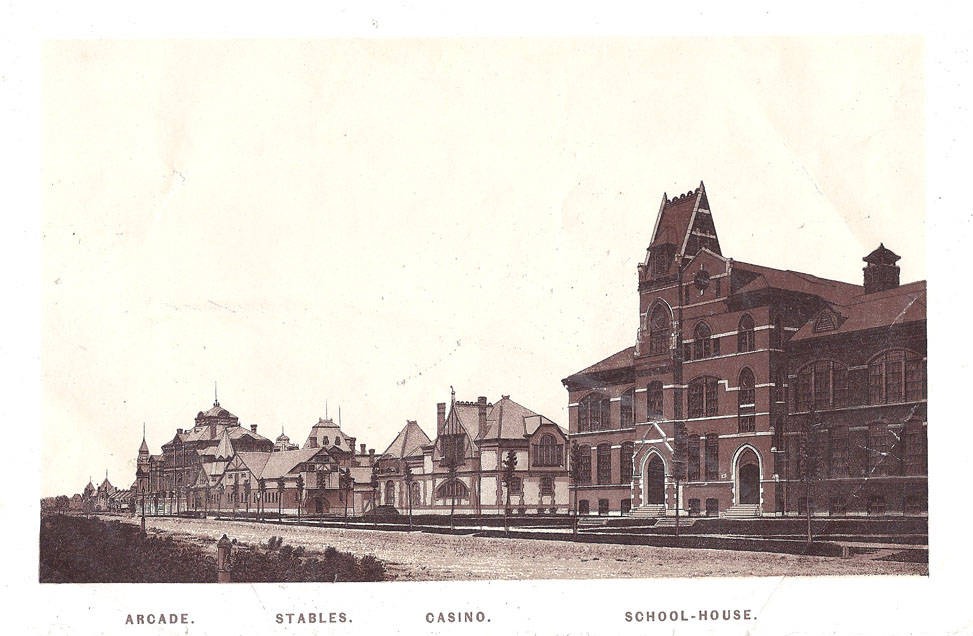
Henry R. Koopman, published in "City of Brick". Public domain. Source and rights record. Resized for web display; no content alteration.

The arrangement also served as a public demonstration of Pullman’s ideas about industrial management. A company could provide orderly surroundings and expect benefits in workforce stability, reputation, and property income. The town was a business undertaking with social ambitions, rather than housing provided as an unconditional gift.
Good housing did not mean identical housing
Pullman’s rowhouses offered amenities that compared favorably with much working-class accommodation of the period. The Park Service’s account of the workers’ homes identifies indoor plumbing, well-lit and ventilated rooms, and different house sizes intended for workers at different levels. Executive homes had amenities that were not universal throughout the town.
This variety matters. Photographs of an elegant frontage should not be taken as proof that every family occupied the same kind of dwelling. A planned community can express hierarchy through building size, location, and rent, even when its architecture has a consistent appearance.
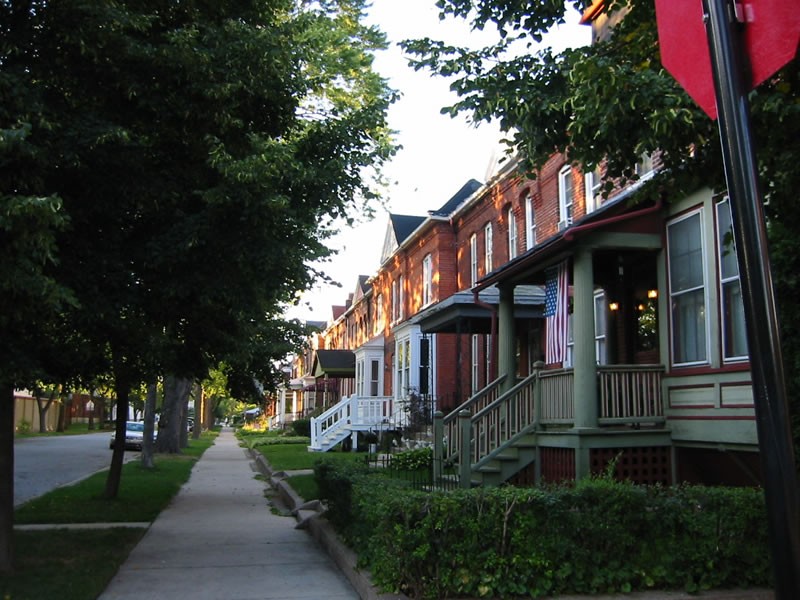
Payton Chung’s 2005 photograph shows surviving rowhouses along a tree-lined street. It illustrates the physical legacy of the company’s residential plan, not the exact condition of a household in the 1880s. Porches, landscaping, maintenance, and daily use have their own subsequent history.
Payton Chung. CC BY 2.0. Source and rights record. Resized for web display; no content alteration.

The rent returned to the company
Workers paid to live in Pullman. The company sought a six-percent return on its investment in the town, although the Park Service notes that actual returns did not reach that target. A home’s usefulness to a family and its role in the company’s accounts existed at the same time.
Ownership was another important distinction. Residents rented company property; they did not initially buy their houses within the company town. Some factory employees lived in surrounding neighborhoods instead. Those communities offered alternatives, including opportunities for property ownership and activities restricted within Pullman’s controlled setting.
It would be inaccurate to describe every company town through the same stereotype. In particular, Pullman did not pay its workers in company scrip, a substitute currency spendable only through a company system. The Park Service’s examination of wage records finds payment in cash rather than scrip and describes how rent collection was connected to paychecks.
That correction does not remove the workers’ dependence. Wages and rent could still move through the same corporate relationship. The precise mechanism matters because it explains how the system functioned, rather than merely supplying an evocative image of the company store.
A downturn exposed the arrangement’s weakness
The financial crisis of 1893 reduced demand for railway equipment. Pullman workers’ wages fell, while rents did not fall correspondingly. A household could lose income without receiving relief on one of its major expenses. The company’s separation of its manufacturing and property calculations became painfully consequential within a worker’s combined household budget.
On May 11, 1894, workers at the Pullman factories began a strike. The Park Service’s strike history traces the dispute from local grievances into a national railway boycott supported by the American Railway Union under Eugene V. Debs.
The boycott targeted the handling of Pullman cars, spreading the consequences far beyond the town. Railway companies, federal officials, union leaders, and communities elsewhere entered a conflict that had begun with wages and working conditions. Federal injunctions and troop deployment helped defeat the movement, and violence in the Chicago railway conflict caused deaths and injuries.
The transformation in scale is crucial. The factory strike, the wider boycott, and confrontations elsewhere were connected, but they were not all events on Pullman’s residential streets. A precise account avoids making the town the setting of every episode associated with its name.
Listening to the record of the dispute
President Grover Cleveland appointed a commission to investigate the strike and boycott in July 1894. The National Archives’ description of the commission’s records identifies this official inquiry. Testimony and reports provide a way to examine claims made by employers and workers rather than rely only on the model town’s publicity.
Different records reveal different priorities. A company’s financial account asks whether the investment produced returns. A worker’s statement can show how wages, rent, and family obligations combined. A government inquiry considers public order, commerce, and the causes of the conflict. None should be mistaken for the entire history.
The labor movement itself also contained exclusions. The American Railway Union did not admit Black members. The National Archives’ history of African American labor places that exclusion within the wider history of union organization. A story about workers seeking power needs to ask which workers the organization represented.
The landlord relationship ended; the larger history continued
In October 1898, the Illinois Supreme Court ordered the company to dispose of its nonindustrial landholdings. Much of the residential town changed hands in 1907, with residents given the first opportunity to buy. Ending company ownership changed the relationship between the houses and the enterprise, although it did not erase the town’s physical plan.
Pullman’s labor history also extended beyond the factory workforce and the 1894 dispute. Sleeping-car porters, many of them African American, organized the Brotherhood of Sleeping Car Porters in 1925 under A. Philip Randolph. After years of struggle, the company signed an agreement with the union in 1937. The Park Service’s account of the porters explains this separate but related campaign for representation and improved conditions.
The distinction between making railway cars and serving passengers aboard them keeps the story coherent. Both belonged to the Pullman enterprise, but they involved different workforces, experiences, and organizing histories.
A neighborhood beyond its original purpose
The surviving homes are privately owned, and Pullman remains a neighborhood as well as a historic place. The buildings preserve evidence of a company plan, while residents’ later lives remind visitors that a town can outlast the arrangement that created it.
Pullman’s importance lies in the coexistence of improvement and control. Its housing could be attractive and its residents’ grievances serious. Its public spaces could be carefully designed while the opportunity to own a home remained restricted. Reading the streets alongside wages, rents, testimony, and ownership records reveals how land can turn an employment relationship into a much larger framework for everyday life.
Sources and further reading
- National Park Service: Pullman overview, workers’ homes, and strike and later history.
- National Park Service: the cash-versus-scrip evidence.
- National Archives: strike commission records and African American labor history.
- National Park Service: Pullman porters.
- National Park Service: historic resource study, planned communities and Pullman, including the casino building’s varied uses.