
Instruments & Methods
The Theodolite: How a Turning Telescope Changed Surveying
From open sights and divided circles to transits, total stations, and robotic tracking, the theodolite’s history is a story of making direction repeatable.
On This Page
- 01 — Introduction
- 02 — Before the Telescope
- 03 — A Name Older Than the Modern Form
- 04 — The Telescope Enters the Line of Sight
- 05 — Divided Circles and the Art of Reading
- 06 — Horizontal and Vertical Axes
- 07 — Faces, Reversals, and Repetition
- 08 — The Transit Theodolite
- 09 — Triangulation and National Frameworks
- 10 — Electronic Theodolites and Total Stations
- 11 — Robotic Tracking and the Modern Line of Sight
- 12 — Reading the Evidence Carefully
- 13 — From Historical Record to Field Practice
- 14 — Why the Theodolite Still Matters
- 15 — A Practical Error Budget
- 16 — Care and Verification in the Instrument Shop
- 17 — A Surveyor’s Reading Checklist
- 18 — Sources and Further Reading
From open sights and divided circles to transits, total stations, and robotic tracking, the theodolite’s history is a story of making direction repeatable.
A theodolite does something deceptively simple: it measures angles. That capability became transformative when a telescope could rotate horizontally and vertically around stable axes, while finely divided circles and reading systems let an observer assign numbers to direction. Networks of triangles could then carry position across country that was impossible to measure directly.
The familiar instrument did not appear fully formed. The word “theodolite” was used in sixteenth-century England for devices unlike a modern model. Telescopes, spirit levels, vertical circles, verniers, micrometers, improved bearings, and manufacturing standards accumulated over centuries. The history belongs as much to instrument makers and observing procedures as to any single inventor.
Theodolites did not make angles trustworthy by themselves; they made it possible to observe, repeat, reverse, compare, and adjust them.
Before the Telescope
Surveyors long used sighting rules, quadrants, circumferentors, plane tables, and other devices to establish directions or measure angles. Open sights limited reach and precision, but they served practical work. The later theodolite inherited concepts from these tools: a centered station, a reference direction, a graduated scale, and a controlled line of sight.
The instrument matters, but the observation system matters more. A reading becomes defensible only when the observer controls setup, centering, calibration, temperature or refraction where relevant, note keeping, repetition, closure, and an independent check. New instruments usually reorganize earlier ideas rather than erasing them. That continuity is one reason an old field book can still feel familiar to a surveyor carrying equipment its author could scarcely imagine.
A Name Older Than the Modern Form
Leonard Digges used the term “theodolitus” in the sixteenth century, although the illustrated instrument was not the telescope theodolite recognized today. The word’s origin remains debated. Its changing meaning is a useful warning: finding a familiar name in an old book does not prove the object had familiar capabilities.
The instrument matters, but the observation system matters more. A reading becomes defensible only when the observer controls setup, centering, calibration, temperature or refraction where relevant, note keeping, repetition, closure, and an independent check. Identify an instrument by its construction and function, not by a label alone. That continuity is one reason an old field book can still feel familiar to a surveyor carrying equipment its author could scarcely imagine.
The Telescope Enters the Line of Sight
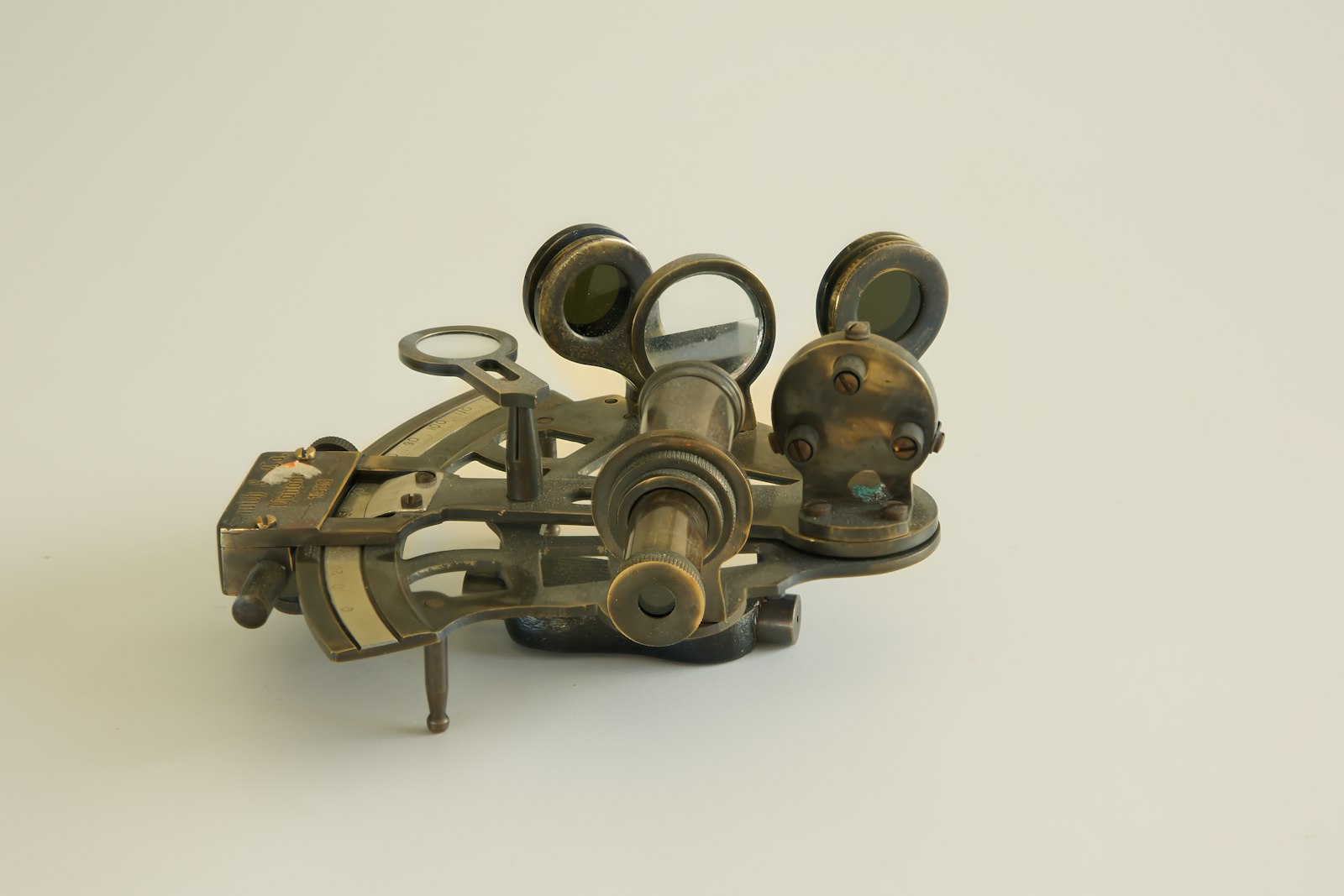
Once telescopic sights were adapted to angle-measuring instruments, observers could define a more precise line toward a distant target. Crosshairs replaced broad visual alignment, and focusing expanded useful range. Optical improvements also introduced new errors—collimation, focus, parallax, and imperfect axes—that demanded tests and adjustments.
The instrument matters, but the observation system matters more. A reading becomes defensible only when the observer controls setup, centering, calibration, temperature or refraction where relevant, note keeping, repetition, closure, and an independent check. Every gain in resolution makes previously negligible setup errors more visible. That continuity is one reason an old field book can still feel familiar to a surveyor carrying equipment its author could scarcely imagine.
Photo: Jean Woloszczyk / Unsplash. Used under the Unsplash License.
Divided Circles and the Art of Reading
A circle is useful only if its graduations are accurately placed and readable. Makers developed engines for dividing scales, verniers for interpolating between marks, and microscopes or micrometers for finer readings. The great eighteenth-century instruments of Jesse Ramsden demonstrated how precision manufacture could support national triangulation.
The instrument matters, but the observation system matters more. A reading becomes defensible only when the observer controls setup, centering, calibration, temperature or refraction where relevant, note keeping, repetition, closure, and an independent check. Instrument precision is partly a manufacturing achievement and partly a disciplined reading procedure. That continuity is one reason an old field book can still feel familiar to a surveyor carrying equipment its author could scarcely imagine.
Horizontal and Vertical Axes
A mature theodolite rotates about a vertical axis for horizontal directions and a horizontal, or trunnion, axis for elevations and depressions. The line of sight, trunnion axis, and standing axis must satisfy geometric relationships. If they do not, observations carry systematic error.
The instrument matters, but the observation system matters more. A reading becomes defensible only when the observer controls setup, centering, calibration, temperature or refraction where relevant, note keeping, repetition, closure, and an independent check. Axis geometry explains why leveling, centering, and calibration are not ceremonial preliminaries. That continuity is one reason an old field book can still feel familiar to a surveyor carrying equipment its author could scarcely imagine.
Faces, Reversals, and Repetition
Surveyors observe on both faces of the instrument so certain collimation and index errors change sign and can be averaged. Repeating an angle or observing a complete set of directions supplies redundancy. These procedures convert a fragile single reading into a small system that can expose blunders and reduce systematic effects.
The instrument matters, but the observation system matters more. A reading becomes defensible only when the observer controls setup, centering, calibration, temperature or refraction where relevant, note keeping, repetition, closure, and an independent check. Redundancy is designed evidence, not wasted motion. That continuity is one reason an old field book can still feel familiar to a surveyor carrying equipment its author could scarcely imagine.
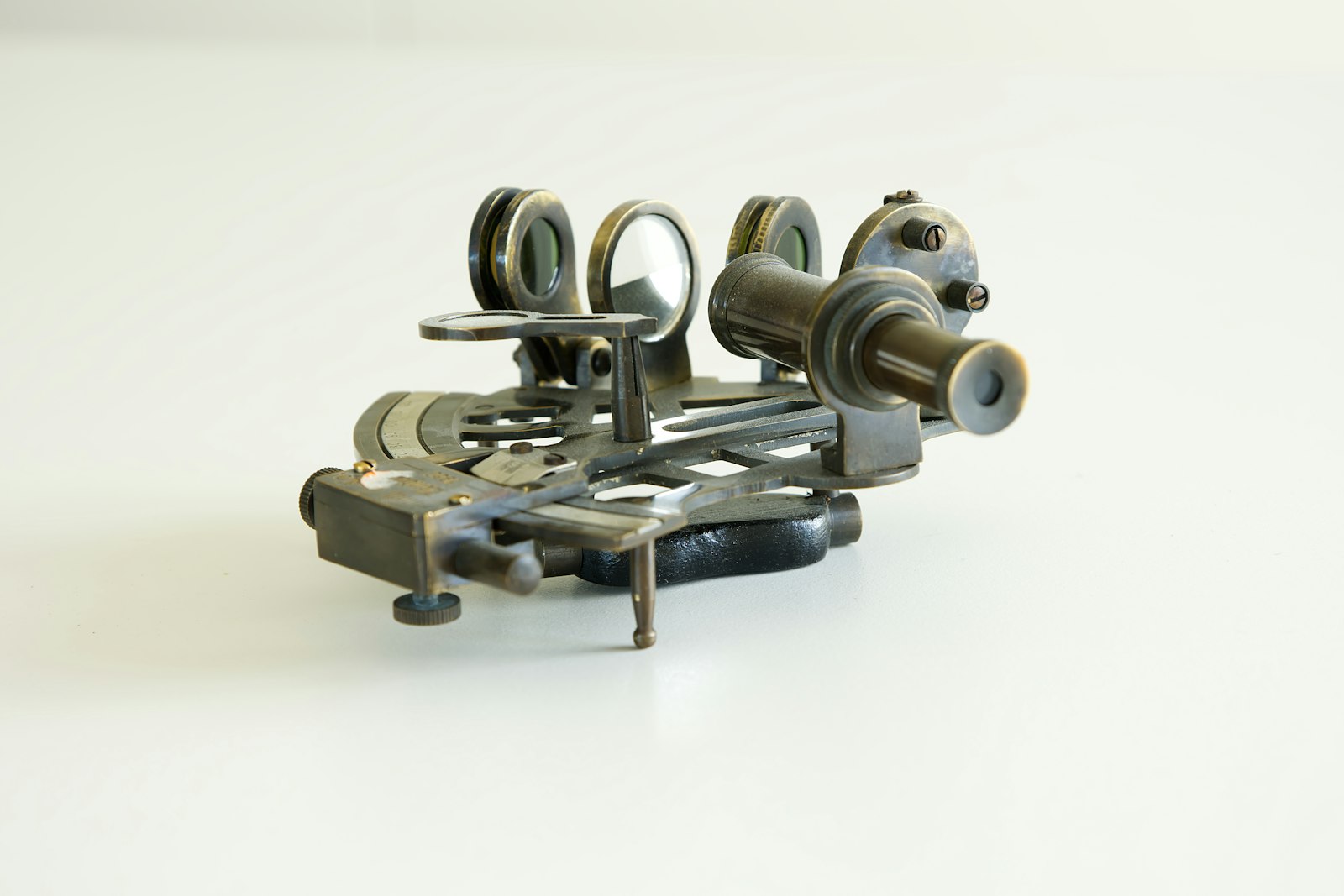
Photo: Jean Woloszczyk / Unsplash. Used under the Unsplash License.
The Transit Theodolite
When the telescope could be rotated completely through the vertical plane, or transited, field procedures became faster and checks easier. In North America, the surveyor’s transit became a defining nineteenth- and twentieth-century instrument. Terminology differed by country and manufacturer, and transit and theodolite were not always used consistently.
The instrument matters, but the observation system matters more. A reading becomes defensible only when the observer controls setup, centering, calibration, temperature or refraction where relevant, note keeping, repetition, closure, and an independent check. Historical equipment records should be interpreted in their regional and commercial context. That continuity is one reason an old field book can still feel familiar to a surveyor carrying equipment its author could scarcely imagine.
Triangulation and National Frameworks
Precise theodolites supported triangulation networks in which measured angles and selected baselines propagated control over great distances. Survey of India operations and national geodetic surveys pushed instrument design and observing discipline under difficult conditions. Adjustment was essential because no network of real observations closes perfectly.
The instrument matters, but the observation system matters more. A reading becomes defensible only when the observer controls setup, centering, calibration, temperature or refraction where relevant, note keeping, repetition, closure, and an independent check. A control network is stronger than any one angle because it distributes and tests evidence. That continuity is one reason an old field book can still feel familiar to a surveyor carrying equipment its author could scarcely imagine.
Electronic Theodolites and Total Stations
Electronic encoders replaced optical circle reading, and electronic distance measurement was combined with angle measurement in the total station. Onboard computation added coordinate geometry, data storage, and stakeout functions. The operator no longer had to read a vernier, but centering, target identification, constants, atmosphere, and reference setup remained critical.
The instrument matters, but the observation system matters more. A reading becomes defensible only when the observer controls setup, centering, calibration, temperature or refraction where relevant, note keeping, repetition, closure, and an independent check. Automation relocates responsibility; it does not remove it. That continuity is one reason an old field book can still feel familiar to a surveyor carrying equipment its author could scarcely imagine.
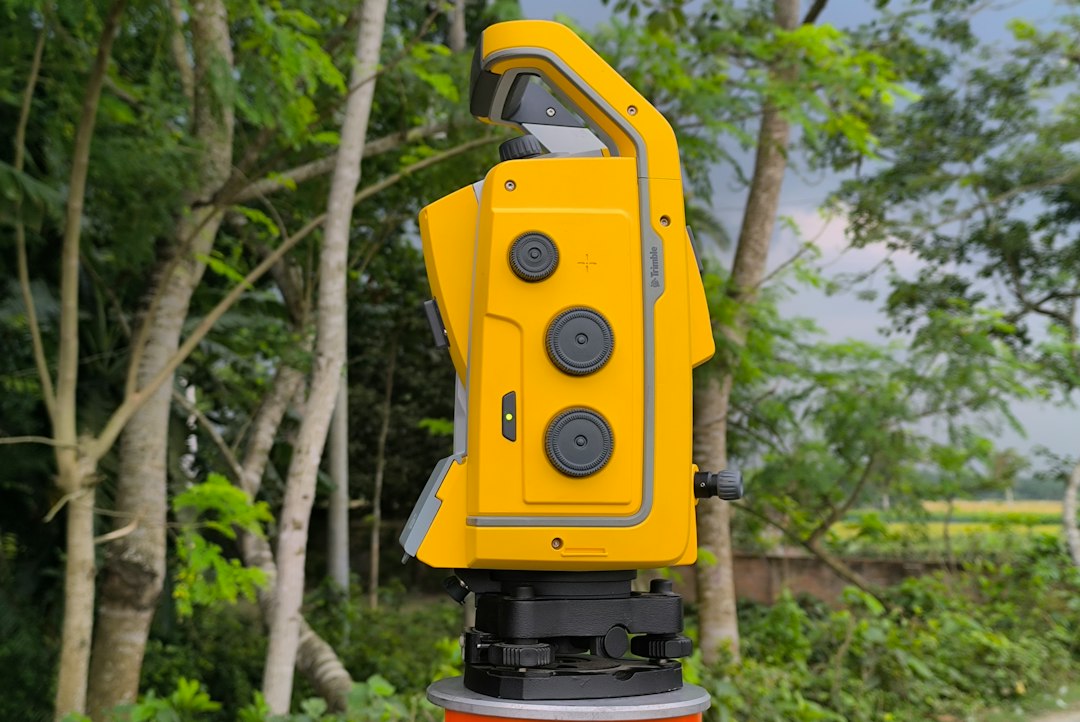
Photo by Nasim Uddin / Unsplash. Used under the Unsplash License. Source.
Robotic Tracking and the Modern Line of Sight
Motorized total stations can search for and track prisms, turn angles automatically, and be controlled at the rod. Imaging and scanning add dense observations. These systems increase productivity and enable monitoring, yet a wrong backsight, unstable control point, or misidentified prism can corrupt an elegant data set very quickly.
The instrument matters, but the observation system matters more. A reading becomes defensible only when the observer controls setup, centering, calibration, temperature or refraction where relevant, note keeping, repetition, closure, and an independent check. Fast observations make good control and independent verification more important, not less. That continuity is one reason an old field book can still feel familiar to a surveyor carrying equipment its author could scarcely imagine.
Reading the Evidence Carefully
Instrument advertisements often promise an angular accuracy as a compact number, but a project result contains more than encoder resolution. Tripod stability, centering, target construction, sight length, pointing conditions, refraction, observation geometry, and control quality all contribute. A one-second instrument does not make every direction a one-second result. Specifications become meaningful only when they are connected to a procedure, environmental limits, and an adjustment that shows how the observations actually behaved.
From Historical Record to Field Practice
Across this history, precision should not be confused with a large number of decimal places. Precision begins with a stated purpose, a suitable reference, controlled observations, and enough redundancy to reveal a mistake. Earlier practitioners expressed those requirements through cords, sight lines, repeated angles, witnesses, and permanent stones. Later surveyors added calibrated chains, optical circles, leveling rods, electronic measurements, satellites, and adjustment software. Every generation gained reach, yet every generation still had to decide which evidence deserved confidence. That judgment—not the novelty of the tool—is the durable craft at the center of surveying.
Why the Theodolite Still Matters
GNSS changed the balance of field work, but angular measurement did not become obsolete. Total stations still establish construction geometry, work under canopy and around structures, monitor movement, and connect details where satellite visibility is poor. Their ancestry remains visible in the same standing axis, line of sight, and need for orientation.
The deeper legacy is procedural. The theodolite taught generations to reverse, repeat, close, compare, and adjust. Those habits belong to surveying even when the instrument on the tripod has a touchscreen and a radio.
A Practical Error Budget
Consider a traverse angle observed with a modern one-second total station. The specification describes one part of expected performance, not the whole result. If the tripod settles, the optical plummet is out of adjustment, the backsight is a short unstable pole, heat shimmer degrades pointing, or the crew records the wrong target, the final direction can be much worse than the instrument label suggests. Good practice attacks those risks in layers: stable setup, precise centering, suitable sight lengths, face-left and face-right observations, repeated sets, closure, and adjustment. Each layer either reduces an error or helps reveal it.
Older theodolite crews developed elaborate observing routines because they could see the connection between procedure and confidence. Electronic instruments hide more of the reading process, so it is easy to mistake convenience for certainty. The appropriate response is not nostalgia. It is to preserve the logic of redundancy while using automation well: store raw observations, review residuals, verify control, and make an independent check that is capable of catching a wrong setup.
Care and Verification in the Instrument Shop
Theodolite history is also the history of adjustment. A traditional instrument could be tested for plate-level error, line-of-sight collimation, trunnion-axis relationships, vertical-circle index, and optical-plummet alignment. Some corrections belonged in the shop; others could be detected or reduced through field observations. Modern equipment packages more mechanisms behind sealed housings, but the principle remains: verify performance on a baseline or controlled network before a critical project, follow the manufacturer’s calibration procedure, and preserve service records.
A check should be capable of revealing the failure under consideration. Repeating an observation from the same unstable setup may demonstrate repeatability while missing a displaced station. Closing a traverse tests more of the system. Observing a known direction or comparing positions from an independent setup tests something different again. Thinking in terms of failure modes turns “check your work” from a slogan into a designed observation plan.
A Surveyor’s Reading Checklist
- Center and level with the precision the work requires.
- Remove parallax before fine pointing.
- Observe both faces when the specification or required accuracy calls for it.
- Record instrument and target heights and confirm the correct prism constant.
- Close on known control or perform an independent orientation check.
Sources and Further Reading
- Smithsonian National Museum of American History: Surveying and Geodesy collections
- NOAA: The History of the Geodetic Survey in the United States
- Encyclopaedia Britannica: Theodolite
Image credits appear with each image. Historical claims are framed to distinguish primary texts and surviving artifacts from later interpretation.